
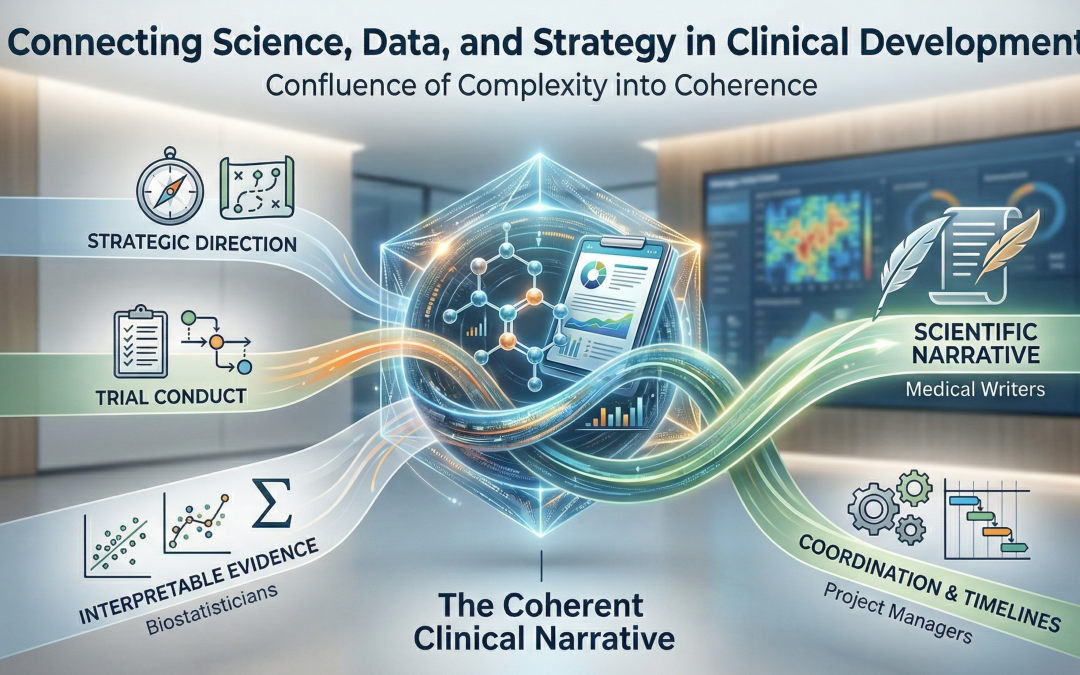
In clinical development, global trials, evolving regulatory expectations, and increasingly sophisticated scientific data place pressure on teams to deliver faster without compromising quality. Success often depends on how effectively diverse expertise—from clinical operations to statistics and scientific communication—works together.
Specialized contributions from several roles
Every successful clinical program relies on contributions from several specialized groups. Each brings critical expertise, but real value emerges when their work converges into a coherent narrative.
-
Sponsors (Pharmaceutical Companies)
Sponsors define the strategic direction of a development program. They determine target indications, key value messages, and the audiences that matter most—from regulators to clinicians and payers. Their strategic framing ultimately guides how scientific evidence should be positioned across the life of a product.
-
CRO Clinical Teams
Clinical operations teams transform strategy into execution. They manage protocols, oversee trial conduct, and ensure that study endpoints, milestones, and operational processes align with the development plan. Their work ensures that the right data is generated at the right time.
-
Biostatisticians
Statistics shapes how trial results become interpretable evidence. Biostatisticians design analytical frameworks, determine appropriate methodologies, and contextualize results. Their work provides the evidentiary backbone for every clinical report, publication, and presentation.
-
Medical Writers
Medical writers sit at the intersection of science, data, and strategy. They synthesize complex inputs—clinical, statistical, and strategic—into clear, scientifically rigorous narratives tailored for specific audiences. From clinical study reports to peer-reviewed manuscripts and conference presentations, they ensure that the science is communicated accurately, consistently, and effectively.
-
Operational and Project Managers
Behind every successful program is strong coordination. Project managers and operational leads maintain timelines, guide review cycles, and facilitate communication across teams. Their oversight keeps complex collaborations moving forward efficiently.
From Complexity to Coherence
The challenge is not the availability of expertise; it is the orchestration of it.
When each function works independently, even highly capable teams can produce fragmented outputs: statistical insights may not fully translate into publications; strategic messaging may drift across deliverables; review cycles may become inefficient as teams attempt to reconcile late-stage inconsistencies.
Cross-functional integration solves these problems, leading to faster deliverable development through clearer alignment across teams; improved scientific consistency across reports, manuscripts, and presentations; more efficient review cycles due to structured coordination and unified messaging; greater confidence that the scientific narrative remains aligned throughout development.
Medical Writers and Project Managers as Strategic Enablers
At TPM Science, we support multidisciplinary clinical teams through medical communications expertise, scientific oversight, and structured project coordination. Our goal is to help complex teams function as a connected system—where strategy, science, and communication move forward together: Click here to get our support