
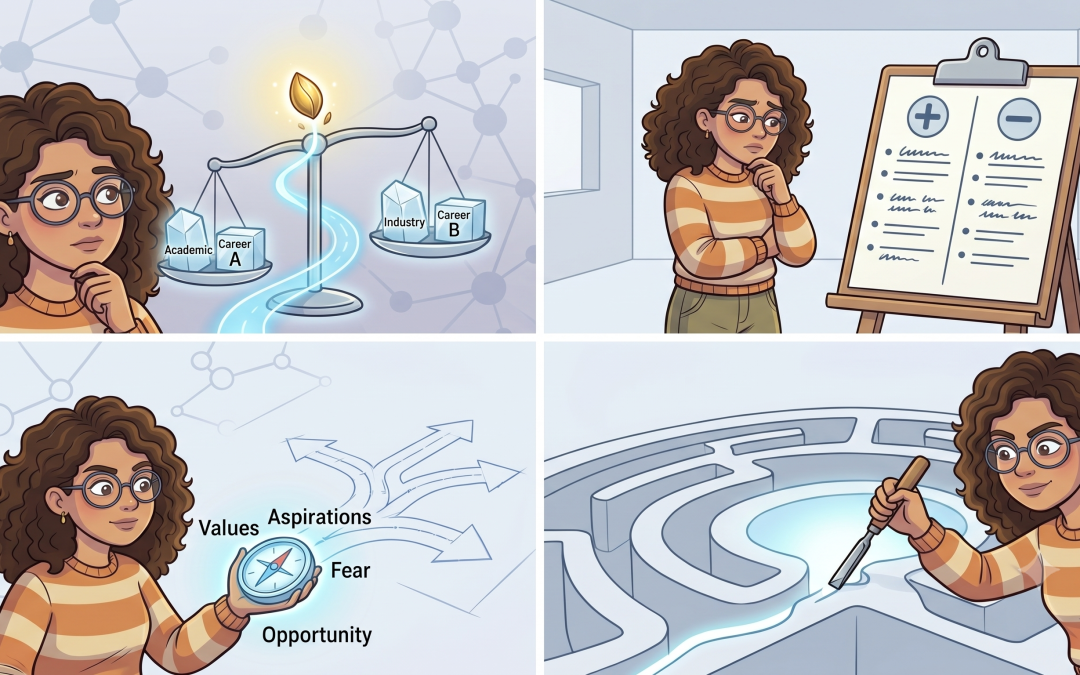
This year, we are running quite a few career development workshops. The first day is all about going introspective and asking ourselves some big questions:
Why are you doing what you are doing? What are your values? And what has influenced your decisions so far?
In our last workshop, this last question especially resonated with many participants. We talked about the different biases that influence our decisions, often without us even noticing.
One of the biases is for example groupthink, where we are strongly influenced by the opinions and choices of the people around us. There is also the availability bias, where we focus on the opportunities that are easiest to see or access. We also have cognitive inertia, our tendency to stick to familiar paths and overlook alternatives. And then there is the sunk cost fallacy: I’ve already invested so much time and effort into this, I can’t possibly stop now. You can identify quite some of these also in my blogpost about the difficult path after my PhD defense.
None of these are inherently bad. In fact, they are part of being human. But becoming aware of them can help us make more informed decisions that are more aligned with our values and aspirations.
It can be incredibly valuable to look back at your CV, your career trajectory, or simply at important turning points in your life and ask yourself: What influenced my decisions at that moment? Which people, opportunities, fears or expectations shaped the path you took?
Still, even with all the self-reflection in the world, making decisions is not easy.
Here are a few things that can help when you are struggling with a choice:
- Make a list of pros and cons.
- Talk to other people and collect experiences and opinions.
- Give yourself time.
- Remember that sometimes there simply isn’t a clearly “right” answer.
And this brings me to one of my favourite TED talks, by Ruth Chang, on hard choices.
Her message is simple, but powerful: hard choices are not difficult because one option is objectively better than the other. They are difficult because both options matter to us. And in the moment of making such a choice, we are not merely discovering who we are — we are actively shaping who we want to become.
I find this thought really empowering.
But what happens after the decision?
Many of us keep wondering whether we chose correctly. We imagine how life would have looked if we had taken the other path. We compare. We regret. We overthink.
If this sounds familiar, here are a few gentle reminders:
- You made the decision with all the knowledge, experiences and emotions you had at that moment. It was the best decision you could make then.
- Remind yourself of your why.
- Try not to idealise the alternative. Every path comes with challenges.
- Stay in the present. Ask yourself: What can I do now?
- Be gentle with yourself.
Comparison, regret and doubt are part of being human. There is no such thing as a perfectly executed life.
There are only choices, experiences, and the opportunity to learn and grow from them.