
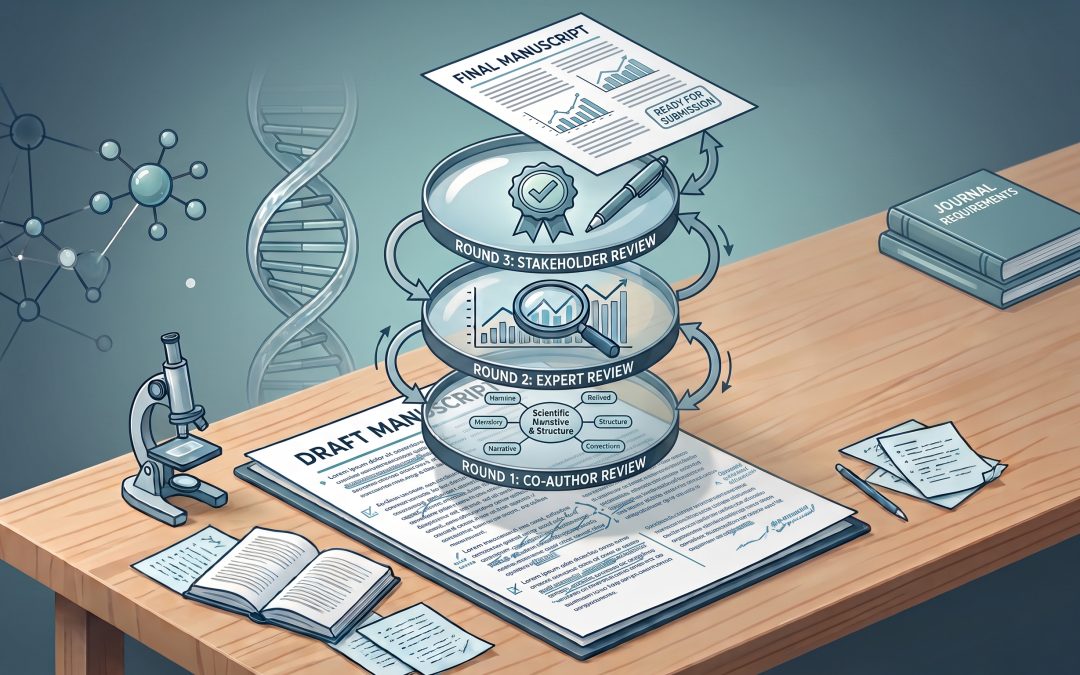
Moving from a linear writing process to a cycle of continuous refinement
Writing a scientific article is often treated as a linear process: conduct the research, analyze the data, write the manuscript, review it, and submit it. In practice, however, the strongest manuscripts rarely emerge from a single writing cycle. They are developed through iteration, a continuous process of writing, testing, revising, and refining the scientific argument.
From the “first version” to progressive refinement
The first version of a manuscript is not expected to be perfect. Its purpose is to make the scientific story visible and provide a basis for critical evaluation.
An iterative process creates opportunities to ask, at successive stages:
- Is the research question clear?
- Does the evidence support the argument?
- Are the results interpreted appropriately?
- Is the key message easy to identify?
- Does the manuscript communicate effectively to its intended audience?
These questions are most valuable when addressed before the manuscript is finalized, when substantial changes are still possible.
Feedback at the right moment
Iteration does not mean sending the same manuscript repeatedly to the same group of reviewers. Rather, different stages call for different types of feedback.
Early rounds should focus on the scientific narrative: the research question, structure, logic, and interpretation of the findings.
Later rounds can address precision, clarity, figures and tables, terminology, and compliance with journal requirements.
This progression allows the manuscript to evolve from a scientifically sound argument into a publication-ready article without spending disproportionate effort polishing sections that may later need to be substantially revised.
The value of multiple perspectives
Scientific writing is also vulnerable to the authors’ own familiarity with the research. After months or years of working on a project, researchers may overlook assumptions or explanations that are not obvious to readers.
Bringing in co-authors, subject-matter experts, methodological specialists, or other relevant stakeholders can challenge these blind spots. Their role is not simply to correct the text, but to test the robustness of the scientific narrative.
Importantly, feedback should be evaluated rather than adopted automatically. The goal is not to satisfy every reviewer, but to use informed perspectives to strengthen the manuscript while preserving a clear and evidence-based message.
Iteration as a quality principle
An effective iterative process requires structure. Each review round should have a defined purpose, appropriate contributors, and a clear timeline. Without these elements, multiple rounds of feedback can become inefficient and even introduce inconsistencies.
When well managed, however, iteration transforms manuscript development from a final editing exercise into a form of progressive quality assurance.
The objective is simple: to ensure that, by the time a manuscript is submitted, its evidence, argument, and message are aligned.
Scientific writing is not a one-time act. It is a process of refinement. Each iteration provides an opportunity to make the science clearer, the argument stronger, and the final publication more robust.
Get in touch if you want to know more about our standardized writing methodology at TPM Science.
Explore our writing services and contact us for support